
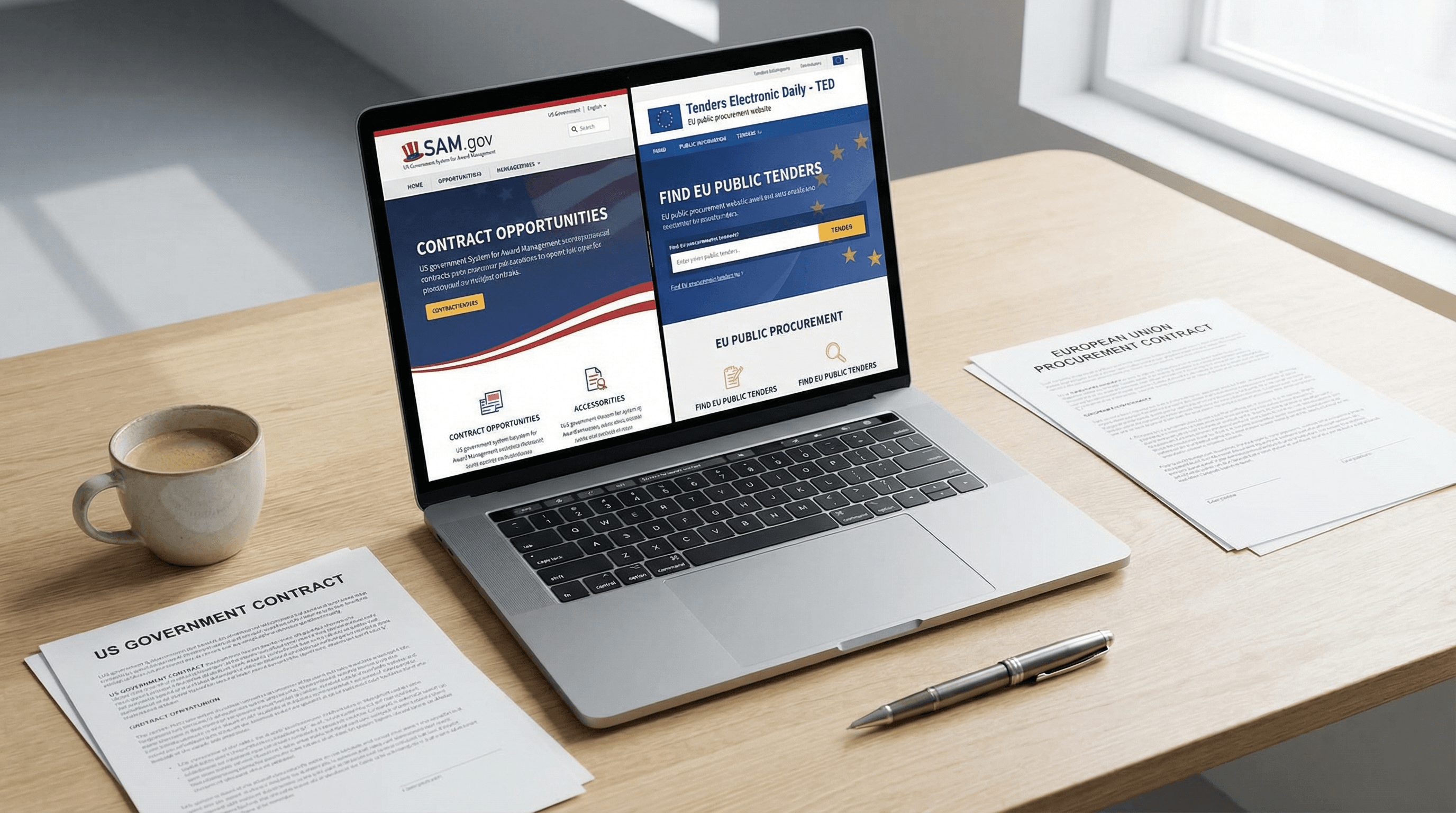
If you're a contractor looking to expand beyond your home market, the US, UK, EU and Canada represent the two largest public procurement markets in the world. The US federal government spends over $700 billion annually on contracts. The EU publishes around 800,000 procurement notices each year, representing roughly €815 billion in contract value.
But these two markets operate on entirely different systems. SAM.gov handles US federal contracting. TED (Tenders Electronic Daily) covers the EU. Understanding how each platform works, and how they differ, is the first step toward building a transatlantic public sector practice.
This article breaks down both systems side by side, with practical guidance for contractors working across both markets.
The Basics: What Each Platform Does
SAM.gov (System for Award Management)
SAM.gov is the US federal government's official system for contractor registration and contract opportunity discovery. It consolidates what used to be multiple separate systems, including the former FedBizOpps (FBO) for contract opportunities and CCR for entity registration.
What you can do on SAM.gov: Register your business to do work with the federal government. Obtain a Unique Entity ID (UEI), which replaced the DUNS number. Search for contract opportunities posted by federal agencies. Access historical contract award data. View exclusion records (debarred or suspended entities). Submit subcontracting reports.
Federal agencies are required to post contract opportunities valued at $25,000 or more on SAM.gov. This is your primary source for US federal procurement at the prime contractor level.
TED (Tenders Electronic Daily)
TED is the online version of the Supplement to the Official Journal of the European Union. It serves as the central publication point for public procurement notices across all 27 EU member states, plus European Economic Area countries (Norway, Iceland, Liechtenstein) and Switzerland.
What you can do on TED: Search for public procurement notices from across the EU. Access prior information notices (early-stage opportunities). View contract award notices (who won what). Download procurement data in bulk for analysis. Set up alerts for specific criteria.
Unlike SAM.gov, TED does not handle contractor registration. Each EU member state has its own registration requirements and procurement platforms for bid submission. TED is purely a publication and discovery platform.
Registration Requirements
SAM.gov Registration
To bid on US federal contracts as a prime contractor, you must have an active SAM.gov registration. The process involves obtaining a Unique Entity ID (UEI) from SAM.gov, completing the entity registration form with company details, NAICS codes, bank information, and points of contact, waiting for validation (typically 7 to 10 business days, sometimes longer), and renewing annually to maintain active status.
For non-US companies, you can register in SAM.gov without a US presence, but you will need a CAGE code (assigned by DLA) and may face additional documentation requirements. Some contracts require US-based performance or security clearances that effectively exclude foreign firms. The registration is free, though many third-party services charge fees to assist with the process.
TED Registration
TED itself requires no registration to search and view procurement notices. Access is free and open to anyone.
However, to actually bid on EU public contracts, you typically need to register with the specific procurement platform used by the contracting authority (varies by country and agency), meet qualification requirements specified in each tender (financial standing, technical capability, insurance, certifications), and in some cases, establish a legal entity in the EU or designate a local representative.
For non-EU companies, the EU is generally open to foreign bidders, particularly for contracts covered by the WTO Government Procurement Agreement (GPA). However, practical barriers exist, including language requirements, local certifications, and familiarity expectations.
Classification Systems: NAICS vs CPV
One of the most significant differences between the two platforms is how they classify goods and services.
NAICS (North American Industry Classification System)
SAM.gov uses NAICS codes to categorize contract opportunities and contractor capabilities. NAICS is a six-digit system organized hierarchically: First two digits indicate the Sector (e.g., 54 = Professional, Scientific, and Technical Services), third digit is the Subsector, fourth digit is the Industry Group, fifth digit is the NAICS Industry, and sixth digit is the National Industry.
When you register in SAM.gov, you select the NAICS codes that describe your business. Contracting officers use these codes to find potential vendors and to classify solicitations. Example: 541512 = Computer Systems Design Services.
CPV (Common Procurement Vocabulary)
TED uses CPV codes, a classification system specific to EU public procurement. CPV codes have eight digits plus a check digit: First two digits indicate the Division, first three digits the Group, first four digits the Class, first five digits the Category, and remaining digits provide further precision. Example: 72212000-4 = Programming services of application software.
The challenge: NAICS and CPV do not map directly to each other. A company classified under one NAICS code in the US may need to identify multiple CPV codes for equivalent work in Europe, or vice versa. There is no official crosswalk, so contractors working in both markets need to learn both systems.
Publication Thresholds
Both systems have minimum contract values below which opportunities may not be publicly advertised.
SAM.gov Thresholds
US federal agencies are required to post opportunities on SAM.gov when the contract value exceeds $25,000. Below this threshold, agencies may use simplified acquisition procedures and may not publicly advertise. For contracts between $25,000 and $250,000 (the Simplified Acquisition Threshold), agencies have more flexibility in procurement methods but still typically post notices. There are no upper thresholds for US federal contracts.
TED Thresholds
The EU operates on a tiered threshold system that determines whether a tender must be published EU-wide.
| Contract Type | Central Government | Other Public Authorities |
|---|---|---|
| Works | €5,538,000 | €5,538,000 |
| Services/Supplies | €143,000 | €221,000 |
| Utilities Sector | €443,000 | €443,000 |
| Defense/Security | €443,000 | €443,000 |
Contracts below these thresholds may be advertised only at the national level, through individual country procurement portals. This means TED does not capture smaller opportunities that might be perfectly suitable for SMEs.
Important note: Thresholds are revised every two years based on currency fluctuations. New thresholds for 2026-2027 were adopted in late 2025.
Search and Discovery Features
Searching SAM.gov
SAM.gov offers several ways to find opportunities. Filters available include keywords, NAICS codes, Product Service Codes (PSC), set-aside types (small business, 8(a), HUBZone, SDVOSB, WOSB), agency, place of performance, response deadline, and notice type (Sources Sought, Presolicitation, Solicitation, Award).
Useful features include saved searches with email alerts, Interested Vendors List (shows who else is tracking an opportunity), attached documents (RFPs, amendments, Q&A), and historical award data through the Data Bank. Limitations include clunky search functionality, basic keyword matching (no advanced Boolean operators), and an interface that requires patience.
Searching TED
TED provides more sophisticated search capabilities. Filters available include CPV codes (with hierarchical tree navigation), country of buyer, place of performance (using NUTS codes for EU regions), procurement value range, type of procedure (open, restricted, negotiated, competitive dialogue), notice type, publication date, submission deadline, and languages accepted for submissions.
Useful features include advanced search with multiple combined criteria, RSS feeds for search results, bulk data downloads (XML format) for analysis, 10-year historical archive, and multiple language versions of notices. Limitations include no contractor registration (so no profile-based matching), actual bid submission happens on separate national platforms, and some notices are only available in the buyer's language.
Notice Types Comparison
| SAM.gov Notice Type | Purpose | TED Equivalent |
|---|---|---|
| Sources Sought | Market research | Prior Information Notice |
| Presolicitation | Advance notice | Prior Information Notice |
| Solicitation/Combined Synopsis | Active opportunity | Contract Notice |
| Award Notice | Announce winner | Contract Award Notice |
| Special Notice | General announcements | Various |
| Sale of Surplus | Asset disposal | (Handled separately) |
Practical Considerations for Cross-Atlantic Contractors
If you're a US company looking at EU opportunities:
Start with English-language tenders. Filter by submission language to find opportunities where you can compete without translation. Focus on sectors where US firms have advantages, such as technology, professional services, and specialized engineering.
Understand that TED is just the starting point. You will need to navigate national e-procurement portals (like DOFFIN in Norway, TenderNed in the Netherlands, or SIMAP in many countries) to actually submit bids. Consider teaming with local partners, as many EU tenders favor or require local presence, local references, or understanding of local regulations. Watch the thresholds—smaller opportunities below EU thresholds won't appear on TED.
If you're an EU company looking at US opportunities:
Get your SAM.gov registration sorted early. The process can take weeks, and you cannot bid without an active registration. Understand NAICS codes thoroughly—selecting the wrong codes limits your visibility to contracting officers.
Research agency-specific requirements. Some agencies (particularly DoD) have additional registration or qualification requirements beyond SAM.gov. Be aware of domestic preferences. Buy American Act provisions, domestic content requirements, and small business set-asides can limit opportunities for foreign firms. Consider the GSA Schedule—for many services, getting on a GSA Schedule contract provides a streamlined path to federal buyers.
Data Access and Analytics
Both platforms provide data access, but with different approaches.
SAM.gov Data Bank allows you to run reports on historical contract awards, including contractor names, award amounts, and contracting agencies. Useful for competitive intelligence and market sizing.
TED Open Data provides bulk downloads of all published notices in XML format, going back to 1993. The EU also offers a TED CSV dataset for easier analysis. More suitable for large-scale data analysis and integration into business intelligence tools.
For contractors serious about pipeline development, combining data from both platforms provides a complete picture of transatlantic public sector opportunities.
Summary Comparison Table
| Feature | SAM.gov (US) | TED (EU) |
|---|---|---|
| Purpose | Registration + Opportunities | Publication only |
| Registration required | Yes, for bidding | No (separate by country) |
| Cost | Free | Free |
| Classification system | NAICS codes | CPV codes |
| Minimum threshold | $25,000 | €143,000 to €5.5M (varies) |
| Languages | English | 24 official EU languages |
| Notice volume | ~50,000+ per year | ~800,000 per year |
| Data access | Data Bank reports | Bulk XML downloads |
| Set-asides for SMEs | Yes (statutory) | Encouraged, not mandated |
| Bid submission | Varies by solicitation | National platforms |
Conclusion
SAM.gov and TED serve similar purposes in different ways. SAM.gov is a more integrated system that handles both registration and opportunity discovery for a single market. TED is a publication platform that aggregates notices from 27+ countries but leaves registration and submission to national systems.
For contractors serious about transatlantic expansion, both platforms are required reading. The opportunities are substantial on both sides of the Atlantic. The contractors who succeed are those who invest time in understanding how each system works, rather than treating international expansion as an afterthought.
BidClever aggregates opportunities from SAM.gov, TED, and national procurement portals across multiple markets, applying AI-powered matching to surface relevant opportunities regardless of which platform they originate from. If you're tired of checking multiple systems and translating between classification codes, see how a unified view can simplify your international pipeline.